

Agents that remember
change everything.
CortexMind gives your AI agents one long-term memory that lives on your machine. Every conversation opens with what you decided, what you prefer and where you left off. Every turn is saved for the next one.
14-day free trial on the monthly plan. macOS, Windows and Linux.

Every session is day one. Until now.
You explain the project again. You restate the rule you set last week. The agent rediscovers the bug it already fixed. Context windows end, and everything in them ends with them.
CortexMind is the part of the stack that was missing: a memory that outlives the conversation, read before the agent plans and written before it stops.
Read how it works
Three steps, then it just runs.
Install once. Your agents boot with memory from the next conversation on.
Install and paste your key
Download the app for macOS, Windows or Linux and paste the license key from your receipt. The app lives in your tray and runs the memory daemon in the background.
Connect your agent
Copy one config snippet from the tray menu into Claude Code, Claude Desktop, ChatGPT, Codex or Cursor. Local agents talk to it on localhost. claude.ai and other hosted agents reach it through the bundled hosted tunnel.
Every conversation starts with memory
The agent boots with your standing rules and the last turns, searches memory as the topic moves, and saves the turn before it ends. You stop repeating yourself.
Or let your AI do all three.
One prompt pasted into Claude Code, Codex, Cursor or any agent with a shell installs the app, connects the agent, moves the memories it already keeps into CortexMind, and interviews you to seed the rest.
Let your AI install itFinds what you meant, not what you typed.
Keyword search and semantic search run side by side and get fused. A cross-encoder then reranks the candidates and lands on the exact passage inside a long note. The importance you set and the age of a memory settle the ties.
No language model sits in the write path. What you save is what gets stored, in full, on your disk.

memory_search("what did we decide about the staging database")
Staging stays on the shared Postgres until the migration lands. Nobody runs the prod-to-dev copy as a test.
The prod-to-dev migration is manual only. Mat runs it, never an agent.
Migration PR 412 merged. Staging still points at the shared instance until the cutover window.
Starts every conversation already knowing your rules.
The boot call returns your standing rules, the preferences and conventions you promoted to the top, plus where the last conversation left off. The agent has them before you type a word.
When the card grows too long, CortexMind tells the agent to ask you to prune it. Your memory stays sharp instead of piling up.
memory_init
Standing rules
- Prices are always quoted in Canadian dollars
- Never include development time estimates in anything
- Tests run in the container, never on the host
- PR descriptions: TLDR first, under 100 words
- Worktrees go outside the repo, never inside it
Where we left off
Migration PR 412 merged, cutover window still to schedule.
Sarah asked for the science lesson as a PDF and a phone page.
Your AI gets better every week.
With a real memory, the model matters less and what it knows about you matters more. Every conversation leaves it a little sharper, and the improvement compounds.
Tell it, and it is a rule
No instructions file to edit, no prompt to rewrite. Say "remember that I want PR descriptions under 100 words" and it is a standing rule from the next conversation on.
The model matters less
Switch models, switch tools, keep the memory. What makes your agent good is what it has accumulated about you and your work, and that stays yours.
Send it to learn
Point it at a topic, a codebase or a pile of documents and let it read. What it saves is there for every agent, every conversation, from then on.
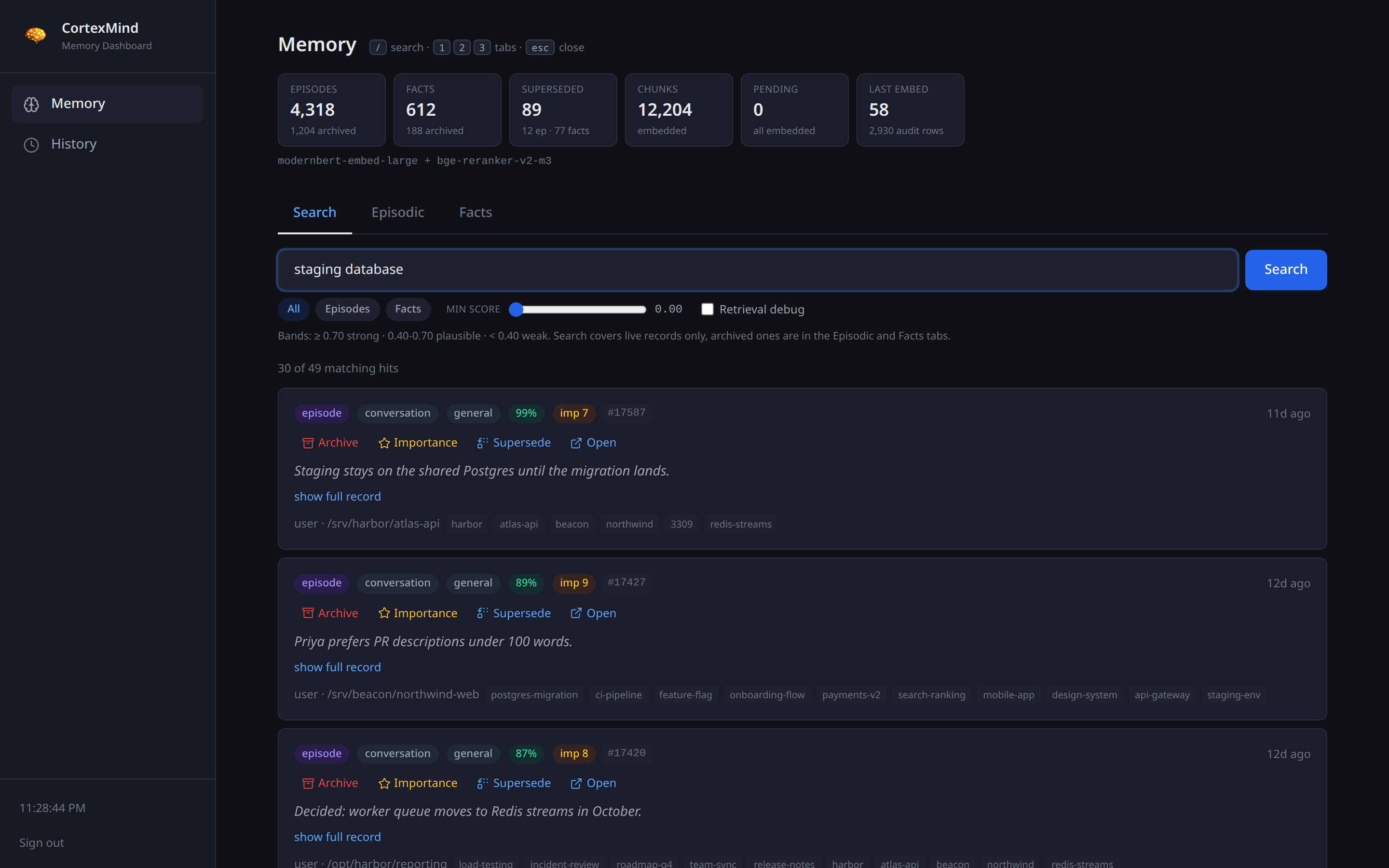
Explore your mind.
A private dashboard on your machine. Browse episodes, inspect facts, search the way your agents do, raise what matters and archive what went stale.
It listens on localhost only. Nothing on it is sent anywhere.
Yours. On your machine.
Local first
Memories live in one SQLite file in your home directory. No account, no cloud sync, no telemetry on your content. Back it up like any other file.
Any GPU, or none
Apple Silicon runs the models on Metal. NVIDIA, AMD and Intel cards run them on Vulkan. No graphics card runs them on the CPU, slower and still correct. Nothing to configure.
Reachable from claude.ai
The license includes a hosted tunnel. Turn it on and claude.ai, ChatGPT or any hosted agent reaches your memory over HTTPS with OAuth, while the data stays home.
One license. Everything included.
A card is required for the trial and nothing is charged for 14 days. Cancel from your customer portal at any time.
14-day free trial
Monthly
$10per month USD
- Every feature
- Hosted tunnel included
- Cancel any time
Save 17%
Yearly
$99per year USD
- Every feature
- Hosted tunnel included
- Two months free
One license activates one machine. Tax is handled at checkout by Polar, the merchant of record. Your license key lives in your customer portal.
Download CortexMind 4.1.1
Already have a license? Pick your platform.
Released September 23, 2026
All releases on GitHubWhat it needs
- Memory
- 16 GB
- Processor
- Any 64-bit CPU. 6 cores or more recommended without a GPU
- Graphics
- Optional. Apple Silicon (Metal) or any Vulkan-capable GPU: NVIDIA, AMD, Intel Arc. About 2 GB of GPU memory in use; an 8 GB card is more than enough
- Disk
- 10 GB free. The models take about 3 GB, downloaded once
- System
- macOS 11 or newer on Apple Silicon, Windows 10 or 11, Linux with glibc 2.39 or newer
Without a graphics card the models run on the CPU and everything still works. With one, CortexMind times your CPU against every GPU it can see on first launch and keeps the fastest.
Questions
Do I need a graphics card?
No. The embedding and reranking models run on the CPU when nothing else is available. A GPU makes saving and recall faster on a large memory, and CortexMind picks it up on its own: Metal on Apple Silicon, Vulkan on NVIDIA, AMD and Intel cards.
Where is my data?
In one SQLite database in your home directory. You can back it up, copy it to another machine or delete it like any file. Nothing is synced to a server.
Which agents can use it?
Any client that speaks MCP. Claude Code, Claude Desktop, claude.ai, ChatGPT, Codex and Cursor are the ones the tray menu has ready-made snippets for.
How does the agent know when to remember?
The tools carry their own instructions: boot with memory_init, search as the topic moves, save before the turn ends. A short block in your CLAUDE.md or system prompt turns that into a habit. The docs page has the block to paste.
Can several agents share one memory?
Yes, that is the point. One daemon on your machine serves every client you connect, so what one agent learns the next one knows.
What happens if I cancel?
The app keeps working until the end of the paid period, plus a 72-hour offline grace. Your database stays on disk untouched. Subscribe again and everything is back.
What leaves my machine?
The license check talks to Polar. If you turn on the hosted tunnel, requests from hosted agents pass through the relay to your machine over HTTPS. Your memories are never uploaded anywhere.
Is there a refund?
The monthly plan starts with a 14-day trial so you can decide before paying anything. For anything else, write to [email protected].
What about the memory my AI already has?
The setup prompt has the agent read through whatever it already remembers, memory files on disk or a built-in memory feature, and save each durable fact into CortexMind. Once that is done it asks you to switch the built-in memory off, so there is one memory, not two competing ones.
Does my computer need to stay on?
Only while you want the memory available. For most people CortexMind runs on the computer they are working on and starts with the session, so there is nothing to think about. If you want claude.ai, ChatGPT or the phone apps to reach your memory at any hour, the machine running CortexMind has to be on and reachable at that moment: leave a home computer running, or install CortexMind on a small VPS in the cloud so it is always online.
How do web and phone apps reach it?
Through the hosted tunnel. Turn it on in the app and CortexMind gets an HTTPS address that claude.ai, ChatGPT or any remote MCP client can add as a connector, signing in with OAuth. The tunnel is EtherTunnel, a separate product: your CortexMind license includes a free EtherTunnel license with one tunnel. Discover EtherTunnel

Give your agents a past.
Fourteen days free, then ten dollars a month or ninety-nine a year.
Start free trial